
The streets weren’t safe after dawn.
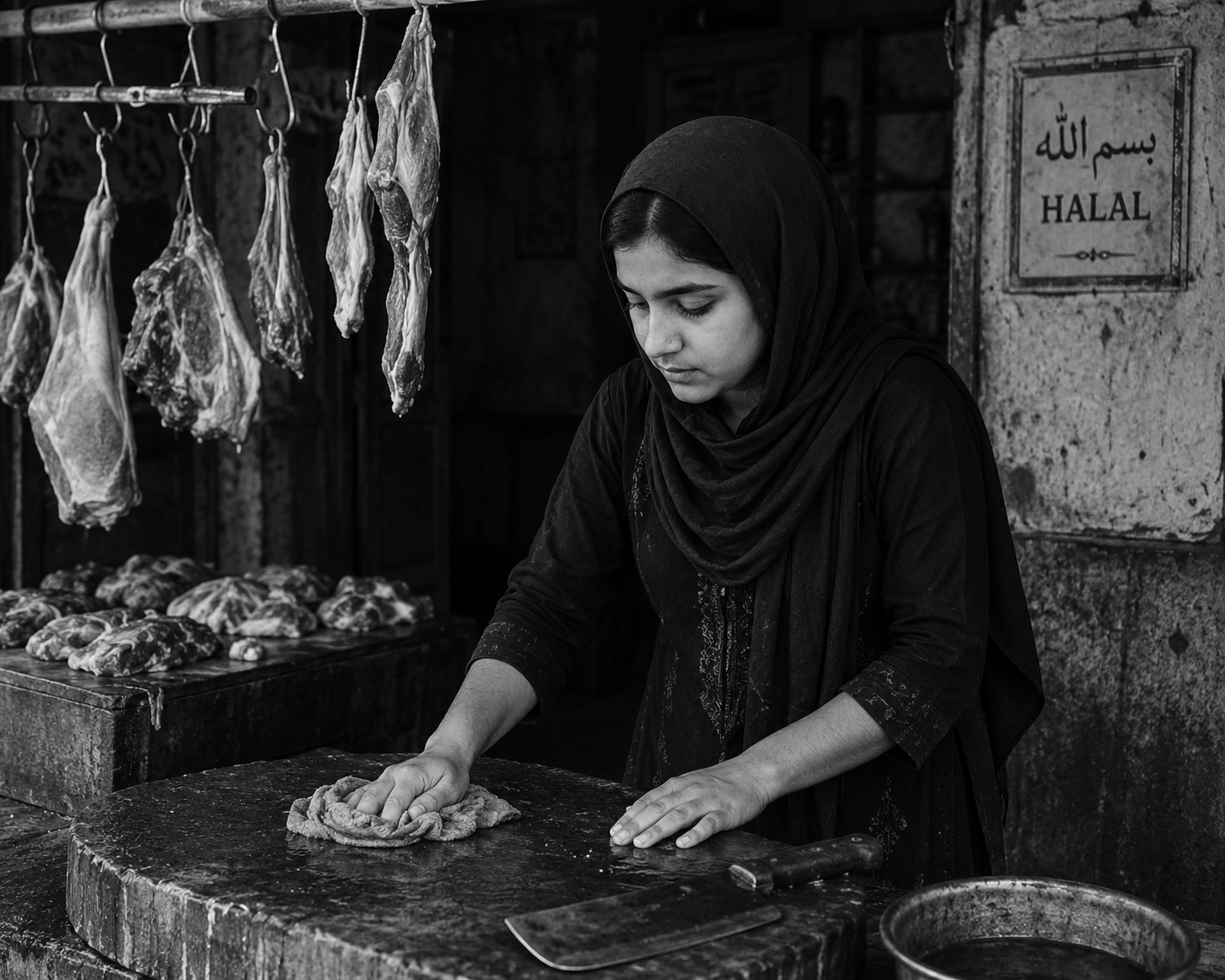
Before the first rays reached the mosque’s minaret in Kizhisseri, Malappuram, Haleema had already scrubbed the previous night’s blood from Hamsa Haji’s chopping block.
The cleaver rested silent. Stray dogs waited patiently for bones to be tossed into the yard.
By sunrise, every door in the village was bolted from inside. The salty breeze from the Arabian Sea carried none of its usual comfort. Men returned from Fajr without their customary stop for kattan chaya. The tea stalls, like every other business in Kizhisseri, now opened only after dusk. Women drew the curtains as the eastern sky turned pale.
Night offered mercy.
Daylight demanded judgment.
After the death of an innocent trader years ago, Kizhisseri quietly reversed its rhythm. Shops opened after dusk. Meat was sold beneath flickering kerosene lamps. Travellers timed their journeys to leave before dawn.
*****
Only Haleema walked the streets after sunrise.
She was sixteen, the maid at Hamsa Haji’s butcher shop. Childbirth had taken her mother. Smallpox had taken her father. With neither land nor kin willing to feed another mouth, Haleema found herself at Hamsa Haji’s doorstep before she was ten. Though the villagers disapproved of a young girl working in a butcher’s shop, Hamsa Haji gave her work when others offered only pity.
She grew up washing blood from chopping blocks, scrubbing knives and sweeping away splintered bones.
“Paavam pennu,” they whispered.
Before closing each night, Hamsa Haji recited softly:
“Indeed, Allah commands justice, excellence, and generosity to close relatives.” (Quran 16:90)
Then he handed Haleema a brass bucket.
“Go wash the stone.”
The broad granite stone at the entrance had been worn smooth by years of scrubbing.
“Soon,” he would mutter, “it will look stained again.”
Not with blood.
With memories.
*****
Years earlier, a mob had dragged an innocent bullock trader through those very streets.
Rumours spread faster than truth.
One accused him of theft.
Another accused him of blasphemy.
By noon, nobody remembered which lie had come first.
The trader lay dead.
The next day every witness denied seeing a thing.
The village buried him.
And buried the truth with him.
Then the mornings changed.
The village baker saw flour turn to ash in his hands.
A sepoy at the thana found fresh fingerprints on the barrel of his musket though he had cleaned it the previous evening.
An old woman drawing water from the village well saw the trader’s face staring back at her.
Fresh wet footprints appeared across the mosque’s stone floor every morning. They were washed away again and again, only to return with the daylight.
Nothing happened after sunset.
Only after dawn.
It was as if daylight exposed guilt.
The old Hakim dismissed it as a sickness of the mind.
The imam called it imtihan.
Old women refused to step outside.
*****
Haleema never saw the visions.
Perhaps because she had never lied to herself.
She had hidden behind a hanging carcass the day the trader died.
She remembered every face.
Including Hamsa Haji’s.
He had not struck the man.
He had merely watched.
Silence, she learned that day, also leaves fingerprints.
*****
One morning after Fajr, just before the congregation dispersed, the imam recited:
“O you who believe, stand firmly for justice, even against yourselves…” (Qur’an 4:135)
The words lingered in the cool morning air.
Hamsa Haji remained seated long after the others had gone.
The verse echoed in his mind all the way home.
That evening, when the butcher’s shop opened after dusk, Hamsa Haji barely spoke to his customers.
After the last customer had gone, he called Haleema.
“You remember the trader?”
She nodded.
“I could have stopped them. Instead, I convinced myself I wasn’t responsible.”
Haleema met his eyes.
“Every dawn Allah returns you to that street. Every night you escape it.”
For the first time in years, Hamsa Haji stood dumbstruck.
*****
When the night’s trade ended, he remained alone inside the shop.
Instead of preparing the chopping block for another night’s business, he unfolded a sheet of paper.
One by one, he wrote the names of everyone who had stood in the street that day.
He wrote his own name last.
At dawn he walked to the thana at Kondotty.
People watched through half-open doors.
“Enthada ithu…” someone whispered.
By noon, others stepped forward.
The tea seller.
The tailor.
The cashew merchant.
Each carried a confession.
Not all had killed.
Many had merely remained silent.
Daylight made no distinction between the hand that struck and the eyes that looked away.
*****
The case was reopened.
Fresh statements were recorded.
Long-buried truths found their way into the official record.
Some were punished.
Others spent the rest of their lives seeking forgiveness from a family that had long stopped expecting it.
The strange visions faded.
Slowly, Kizhisseri returned to its old rhythm.
Shops opened with the morning.
Tea stalls filled after Fajr once more, and the aroma of fresh kattan chaya drifted through the streets.
Yet one thing never changed.
Every morning, Hamsa Haji washed the broad granite stone until it gleamed.
Some burdens belonged only to the hands that created them.
No one called Haleema the butcher’s maid anymore.
She had long since become family.
She spent her afternoons at the madrasa, determined to teach children that faith meant little without truth, justice, and the courage to stand for both.
The villagers accepted the old butcher’s morning ritual without a word.
Only Haleema knew what he was trying to wash away.
Some stains are not removed by water.
Some streets become unsafe after dawn because conscience wakes with the sun.
Darkness hides monsters.
Morning introduces them by their real names.
**************
Glossary:
Fajr (Arabic) – Morning Prayer (first of the five daily prayers -Salah for Muslims)
kattan chaya ( Mal) – Black tea
Paavam pennu( Mal) – poor girl
Hakim (Arabic)- Physician
Imtihan (Arabic)- test
Thana– Police station
“Enthada ithu…(Mal)- What is this ( shocked expression)
Madrasa (Arabic)- Religious school
PC : AI generated image of a girl working in a meat shop ( as Unsplash and other free sites couldn’t give me a relatable one)